


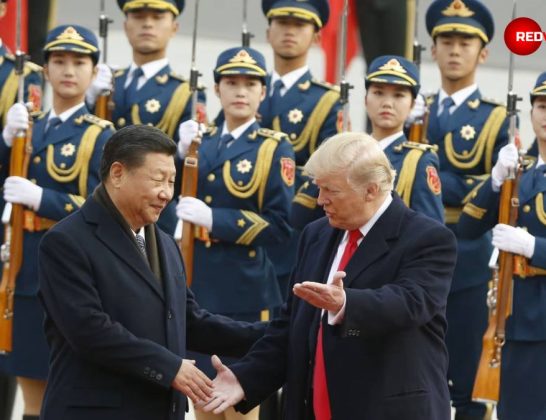
Kathmandu: US President Donald Trump’s visit to China this week is being viewed as a historic opportunity that could redefine trade ties and strategic competition between the world’s two largest economies.
However, analysts say meaningful progress will depend on whether Trump and Chinese President Xi Jinping can find common ground on complex issues including technology, trade, rare earth minerals, Taiwan and the ongoing Iran war.
The trip marks the first visit to China by a US president since 2017. But unlike Trump’s earlier visit during his first term, the geopolitical landscape has dramatically changed with Washington and Beijing now standing on opposite sides of an increasingly polarized global order.
Tensions have been further intensified by China’s close ties with Iran, which has resisted US pressure to end the ongoing conflict in the Middle East.
China itself has also transformed significantly since Trump first launched a trade and technology war against Beijing during his initial presidency. Over the past several years, China has expanded its export capacity and made major advances in high tech industries.
Trump is now meeting a far more powerful Xi Jinping, who has consolidated his authority and extended his leadership beyond traditional term limits. Trump, meanwhile, is serving what US law defines as his final presidential term while reshaping America’s foreign policy direction.
The visit also includes the kind of grand ceremonial events Trump is known to favor, including a tour of the Temple of Heaven and a state banquet hosted by the Chinese leadership.
Iran War Overshadows Talks
Relations between Trump and Xi had slightly improved following their meeting in South Korea last October, where both sides reached agreements on tariff relief and trade cooperation. Another summit planned for March was postponed because of rising tensions in the Middle East.
Trump reportedly wanted to prevent the Iran conflict from dominating his China visit but the war has now entered its third month with no clear path toward peace.
Speaking earlier this week, Trump described the Iran ceasefire situation as being in an “extremely fragile condition.”
He has also confirmed that Iran will be a major topic during discussions with Xi Jinping.
“Xi Jinping has behaved very well so far,” Trump said. “They import a lot of oil from that region but there has not been a problem.”
Iranian Foreign Minister Abbas Araghchi recently traveled to Beijing, underlining the growing strategic relationship between China and Iran.
According to US intelligence claims, China is preparing to provide Iran with a new air defense system, although Beijing has denied the allegation.
Washington is expected to pressure China to help push Iran toward reopening the Strait of Hormuz and accepting a peace agreement.
Ahead of the trip, the United States also imposed sanctions on 12 individuals and organizations accused of helping transport Iranian oil to China.
Taiwan and Trade in Focus
US officials believe Xi Jinping may use the summit to push for changes in Washington’s Taiwan policy. Trump himself acknowledged that “Xi will probably raise Taiwan more than I will.”
Although the United States recognizes the “One China” policy, it has not formally accepted Taiwan as part of China and continues to provide defensive weapons to Taipei.
Trade is also expected to dominate the discussions. US Treasury Secretary Scott Bessent is scheduled to hold talks with Chinese Vice Premier He Lifeng.
The American delegation includes Tim Cook and Elon Musk, highlighting the importance of technology and business interests during the visit.
New agreements in aerospace, agriculture and energy sectors could also be announced, while competition in artificial intelligence is expected to be another major agenda item.
China Seeking Stability and Leverage
Beijing reportedly sees both the Iran conflict and upcoming US midterm elections as opportunities to strengthen its negotiating position.
China’s immediate priority is believed to be preserving the trade truce reached in South Korea and using its dominance in rare earth mineral supplies and large domestic market to pressure Washington into easing restrictions on high tech exports.
Beijing is also expected to demand clearer US opposition to Taiwanese independence and reduced American arms sales to Taiwan.
Chinese officials may additionally seek wider access for Chinese companies, particularly electric vehicle manufacturers in the US market.
Within China, Trump is reportedly viewed as a leader who urgently needs major achievements to present to American voters. Analysts believe Beijing could use potential purchases of US agricultural products and Boeing aircraft as bargaining tools.
For Xi Jinping, maintaining stable US-China relations is considered critical for China’s continued rise. Chinese policymakers are expected to regard any improvement in stability between the two powers after this visit as a major diplomatic success.





Comments