
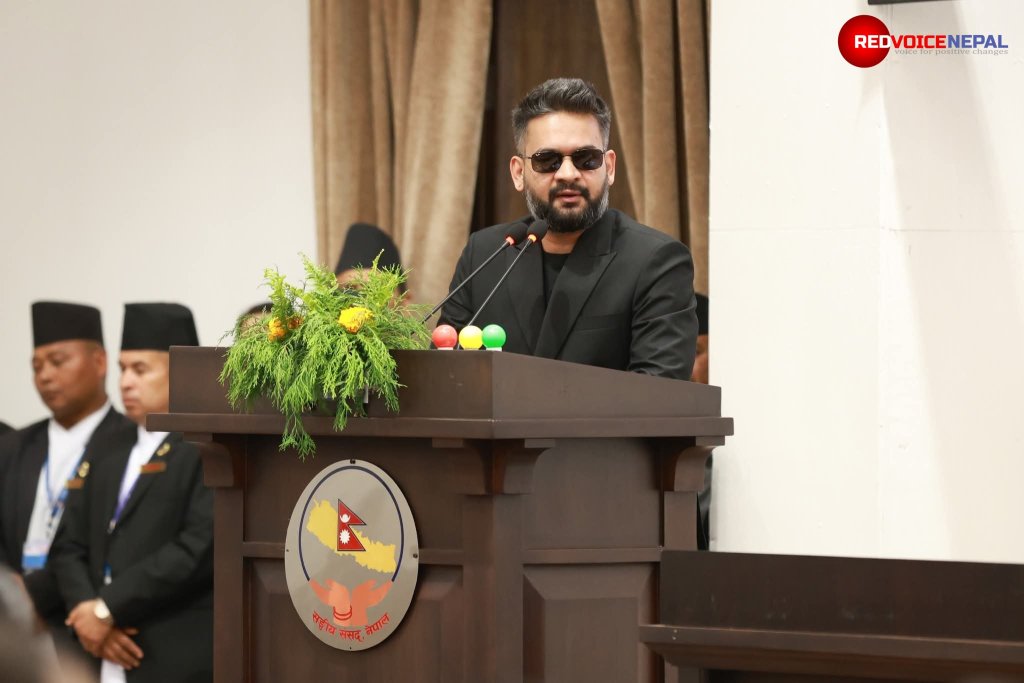
Kathmandu: Prime Minister Balendra Shah (Balen) spoke in the House of Representatives for the first time on Sunday, responding to lawmakers’ questions on a range of national issues including landless settlers, Nepal-India border disputes, electricity infrastructure, economic priorities and voting rights for Nepalis abroad.
The Prime Minister, who was elected to the House on Falgun 21, took the floor after seeking time from Speaker Dol Prasad Aryal during the parliamentary session.
Lawmakers from the Nepali Congress, CPN-UML, Nepal Communist Party, Labour Culture Party and Rastriya Prajatantra Party had raised questions to the Prime Minister.
Key points from the Prime Minister’s remarks:
Commission reports:
Shah said the government would conduct a comprehensive review of reports submitted by various commissions before taking necessary action.
Nepal-India border dispute:
He stated that diplomatic notes have been exchanged with India regarding the Lipulekh and Limpiyadhura issues, and that a response has been received from the Indian side. Shah also claimed that encroachments were found on both sides of the border and said discussions were ongoing with the government of United Kingdom regarding the matter.
Landless settlers:
Addressing the long-standing issue of landless settlers, Shah said a problem that has remained unresolved for 35 years cannot be expected to be solved within 35 minutes.
Economic priorities:
The Prime Minister said the government’s immediate focus is on strengthening public confidence and increasing economic activity, stressing that the country first needs to generate more wealth.
Political rhetoric:
He remarked that delivering speeches on socialism and communism is easy, while claiming that his tenure at the Kathmandu Metropolitan City demonstrated practical achievements in education and healthcare.
Electricity and electric stoves:
Shah warned that the current power infrastructure could come under strain if all households switched to electric stoves immediately, saying transformers could fail under increased demand. He added that the five percent VAT collected from electricity would be used to upgrade and replace transformers.
Voting rights for Nepalis abroad:
The Prime Minister said the government is studying ways to provide voting rights to Nepali citizens living overseas.
The address marked Shah’s first appearance in Parliament as Prime Minister and touched on several issues that have remained at the center of public and political debate in Nepal.
You must be logged in to post a comment.