

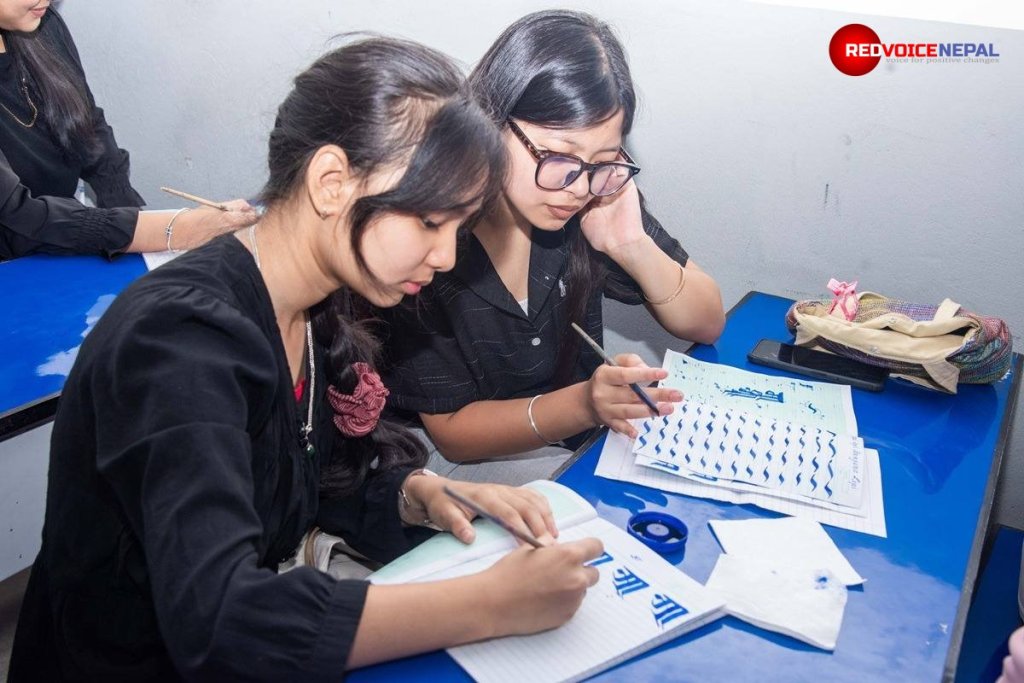
Kathmandu: Kathmandu Metropolitan City Ward No. 17 has launched a 20 day Ranjana script writing training program for local residents, aiming to promote and preserve Nepal’s indigenous linguistic and cultural heritage.
The training began on May 26, is being conducted at Shanti Shiksha Mandir Secondary School in Thahiti. Around 30 participants attend the classes daily from 5:30 p.m.
Ward Chairperson and Kathmandu Metropolitan City spokesperson Nabin Manandhar has been regularly attending the sessions to encourage participants and take part in the learning activities himself.
“Nepal Bhasa is the official working language of our province, and the Ranjana script is a unique symbol of Nepal’s identity recognized internationally,” Manandhar said.
“We initiated this training to promote the working language and preserve our original script. Ranjana is not merely a script; it is also a form of calligraphic art. People who learn it often develop better handwriting.”

Highlighting the diverse participation in the training, he noted that children as young as seven and individuals up to 60 years old are learning together in the same classroom.
“There have been no difficulties in teaching participants of different age groups. We realized that we simply had not made such efforts before.
Through cooperation with local residents, we aim to create records in our indigenous script and contribute to the preservation and promotion of our language and writing system,” he said.
Manandhar also emphasized the historical significance of Nepal Lipi and Nepal Sambat, describing them as indigenous identities developed in Nepal.
“When Nepal sought international recognition as a distinct state, the Ranjana script developed in Nepal was presented as the country’s own script. This training will play an important role in preserving such historical legacies,” he added.
The training covers Nepal Lipi, Ranjana script, numerals, and calligraphy skills.
According to chief trainer Anil Sthapit, president of Nepal Lipi Guthi, Nepal Bhasa and Ranjana script contain 13 vowels, including six primary vowel characters and four forms of vowel markers.
The script also has 41 consonants, five more than the 36 consonants found in Devanagari.
“Nepal Bhasa is largely composed of short vowel sounds, and even words borrowed from Sanskrit have gradually been adapted into native forms,” Sthapit explained.
The earliest script found in Nepal is believed to be the Brahmi script inscribed on the Ashoka Pillar in Lumbini. Nepal Lipi is thought to have originated in Nepal during the 9th century.
One of the earliest known manuscripts written in Nepal Bhasa, Lankavatara, related to medical knowledge, dates back to the early 10th century (Nepal Sambat 28).
The 13th century is regarded as a major period of development for the script, during which manuscripts covering religion, architecture, literature, rituals, astrology, culture, medicine and urban planning were produced. Since these works were handwritten, they existed in limited numbers.
Sthapit said that approximately 15,000 such manuscripts are preserved at the National Archives while around 20,000 are housed at Asha Saphu Kuthi, a community established archive dedicated to preserving traditional scripts.
With the advent of digital technology, Nepal Lipi and Ranjana script were incorporated into Unicode in 2016, making them more accessible for digital use.
Today, language translation tools and modern technology have also made the study and learning of these scripts easier for a wider audience.
You must be logged in to post a comment.