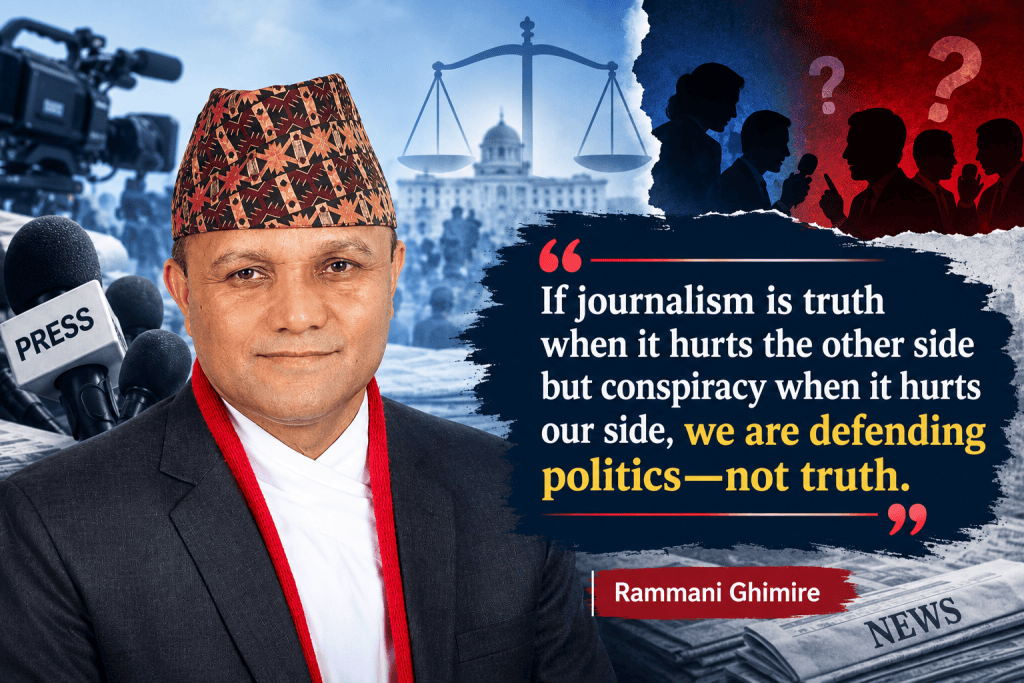
Journalism is supposed to be one of democracy’s most important watchdogs. It questions those in power, demands accountability and brings matters of public interest into the public domain. But journalism faces a serious credibility crisis when the truth of a report is judged not by evidence and facts, but by political loyalty, personal relationships or whether the news is convenient to one’s side.
The controversy surrounding Jana Aastha and its editor Kishor Shrestha, following the publication of an audio recording allegedly linked to Rastriya Swatantra Party lawmaker Khagendra Sunar, has raised precisely this uncomfortable question: Have our standards for judging news remained consistent, or do they change according to our political interests?
The question is particularly relevant because Sunar has denied that the voice in the recording is his and has alleged that artificial intelligence or other technology may have been used to fabricate the audio. The RSP has initiated an internal investigation, while authorities have said that a formal criminal investigation would require a complaint. Independent reporting has also noted that the authenticity of the recording and the identity of the voices have yet to be conclusively established.
That uncertainty is precisely why the debate should be about evidence—not political allegiance.
Is journalism credible only when it targets the other side?
Nepal’s political discourse has repeatedly displayed an uncomfortable double standard.
When a report exposes an opponent, it is often celebrated as courageous journalism. When a report raises questions about someone from our own political camp, the same journalism suddenly becomes a conspiracy.
When an audio recording hurts an opponent, people demand accountability. When an audio recording creates discomfort within their own political camp, they immediately question the journalist, the source, the motive and the technology behind it.
That is not skepticism. At its worst, it is selective skepticism.
The recent controversy involving Sunar is a useful test of this tendency. The publication of an audio recording does not automatically prove every allegation contained in it. At the same time, the political identity of the person accused does not provide sufficient grounds to dismiss the recording as fabricated.
Both conclusions require evidence.
If the audio is incomplete, its full context should be established. If the voice is disputed, forensic examination should be conducted. If the report contains factual errors, those errors should be challenged with evidence. If the allegations are false, the person concerned should have every opportunity to establish that through a credible investigation.
But declaring something a conspiracy simply because it is politically inconvenient is not a substitute for investigation.
The standard must remain the same
This is not an argument against criticism of Jana Aastha, Kishor Shrestha or any other journalist.
Journalists are not above scrutiny. Media organisations must be questioned about their sources, evidence, editorial decisions, context and fairness. A journalist’s reputation does not automatically make every report accurate. Likewise, disagreement with a journalist does not automatically make a report false.
The proper test is the same in every case: What is the evidence?
This principle should apply regardless of whether the person at the centre of a report is a politician we support or one we oppose.
If an audio recording was considered sufficient reason to demand accountability when it involved a political opponent, then the same demand for verification must apply when the recording concerns someone from our own political camp.
If we questioned the authenticity of evidence yesterday, we should be equally prepared to question it today. If we demanded transparency from one political party, we must demand it from another.
Otherwise, we are not defending truth. We are defending our side.
Allegation, evidence and guilt are different things
There is another important distinction that public debate often ignores.
An allegation is not a conviction. A news report is not a court verdict. The publication of evidence does not automatically establish criminal responsibility.
This distinction is particularly important in sensitive cases involving alleged sexual abuse, threats, blackmail or financial misconduct.
The responsible position is therefore neither to declare the accused guilty nor to dismiss the allegations without investigation.
The responsible position is to demand a credible process capable of determining what actually happened.
In the current Sunar controversy, the RSP itself has recognised the seriousness of the allegations and launched an internal investigation, while barring Sunar from formal public events in his capacity as a public office-holder until the inquiry is completed. The party has also said it will cooperate with state investigations.
That is the direction the debate should take: investigation first, conclusion later.
Political loyalty cannot become a substitute for evidence
Political belief is not a crime. Citizens have every right to support a political party, identify with a leader or believe in a political movement.
But political support cannot mean placing one’s preferred politician beyond scrutiny.
Likewise, disliking a politician does not justify accepting every accusation against them as fact.
The real test of political maturity is not how we react when allegations are made against someone we dislike. It is how we respond when credible questions are raised about someone we support.
It is easy to demand accountability from the other side.
The harder task is to demand the same accountability from our own side.
That is where democratic culture is tested.
Journalism needs skepticism—but so does the audience
The answer is not blind trust in the media.
Citizens should question journalists. They should ask where a recording came from, when it was made, whether it has been edited, who verified it and whether independent evidence supports the claims surrounding it.
But skepticism must itself be evidence-based.
The question should not be, “Who benefits from this story?”
The first question should be, “What can actually be established from the evidence?”
This distinction is becoming even more important in an age of artificial intelligence, voice cloning and digitally manipulated content. A claim that an audio recording is AI-generated should itself be testable. It should not simply be accepted because the allegation is politically convenient.
Similarly, publishing an audio recording and attributing a voice to a particular person carries a heavy responsibility. The media must be prepared to substantiate that attribution through credible evidence.
Both sides therefore have obligations.
The media must verify.
The accused must respond.
Authorities must investigate.
And the public must wait for evidence before reaching final conclusions.
The danger of selective outrage
Nepal’s political discourse has too often turned journalism into a weapon.
A report damaging an opponent becomes “investigative journalism.” A report damaging one’s own side becomes “character assassination.”
A journalist exposing someone else is praised for courage. The same journalist investigating our preferred politician is accused of having a hidden agenda.
This selective outrage is dangerous because it destroys the very standard by which journalism can be judged.
If every uncomfortable report is labelled a conspiracy and every favourable report is accepted without scrutiny, public debate becomes impossible.
People stop asking what is true and start asking only what helps their side.
That is how misinformation flourishes.
That is how propaganda replaces journalism.
And that is how citizens lose the ability to distinguish evidence from political convenience.
Journalism should be judged by the quality of its work
There is nothing wrong with challenging Jana Aastha or Kishor Shrestha.
There is nothing wrong with asking whether a published audio recording is authentic.
There is nothing wrong with demanding the identities of sources, independent verification and forensic examination.
In fact, such questions are necessary.
But the same questions must be asked consistently.
A media outlet should not become credible simply because it publishes material against a political rival. Nor should it become automatically unreliable because it publishes something uncomfortable about a political ally.
Journalism should be judged by its evidence, accuracy, context, public interest and willingness to correct mistakes.
That standard must apply equally to every journalist, every media organisation and every political actor.
The question ultimately concerns our own conscience
The controversy is therefore bigger than Jana Aastha.
It is bigger than Kishor Shrestha.
It is bigger than Khagendra Sunar.
It is ultimately about us.
Are we committed to truth—or merely to the interests of our own political camp?
Are we demanding evidence because we genuinely believe in due process, or because the allegation is inconvenient for someone we support?
Are we defending journalism, or only the journalism that serves our preferred narrative?
These are uncomfortable questions, but democracy depends on asking them.
Truth does not become truth only when it benefits us. Nor does an allegation become a conspiracy merely because it hurts our political side.
If the audio is genuine, evidence should establish it.
If it is fabricated, evidence should expose that too.
If the report contains errors, those errors should be corrected.
If the allegations are substantiated, the law should take its course.
And if they are disproved, the accused should be cleared without political prejudice.
That is the only consistent standard.
Question the media. Demand evidence. Demand accountability. Demand investigation.
But let us not use political convenience as a substitute for morality.
Because standing on the side of truth does not mean protecting the person we like.
It means having the courage to accept the evidence—even when the truth is about someone we would rather defend.
Truth must stand above political loyalty.
Otherwise, we are not really seeking justice.
We are simply giving the victory of our own side the name of justice.

Continue to comment