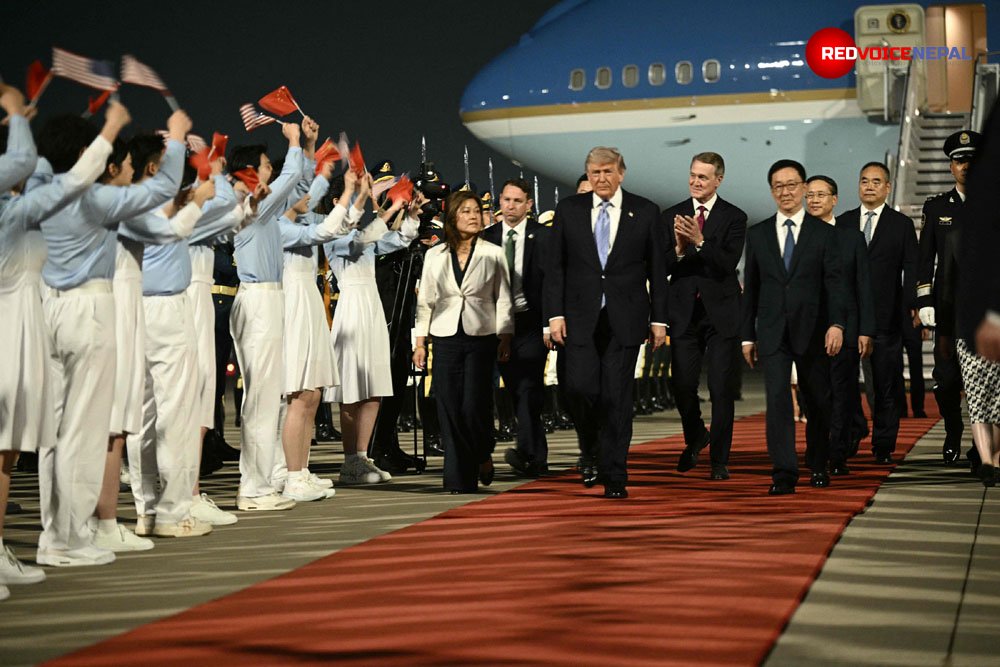
BEIJING: Beijing Capital International Airport glowed under bright lights on Wednesday evening as Air Force One touched down on the runway. China had prepared one of its grandest diplomatic welcomes for U.S. President Donald Trump, signaling the high stakes surrounding the visit.
As the aircraft door opened, Trump emerged smiling alongside his son, Eric Trump. A long red carpet stretched across the airport tarmac, surrounded by Chinese and American flags under dazzling lights.
In a rare gesture of respect, China sent Vice President Han Zheng to personally receive Trump, a level of protocol usually reserved for the most significant state visits. Han greeted the U.S. president with a firm handshake as cameras captured the symbolic moment.
Walking beside Trump were two of America’s most influential technology leaders: Elon Musk and Jensen Huang. Musk appeared in a black suit with his trademark confidence, while Huang smiled warmly, reflecting Nvidia’s deep commercial ties with the Chinese market. Their presence underscored that the visit is not only diplomatic but also deeply tied to trade, technology and global business interests.
Trump waved to officials and media gathered at the airport, visibly pleased by the warm reception. Unlike his 2017 visit, which analysts described as more restrained, China this time offered full ceremonial honors. The carefully staged red carpet welcome reflected the importance both countries place on stabilizing relations between the world’s two largest economies.
During the brief walk across the carpet, Trump was seen exchanging remarks with Musk and Huang, highlighting Washington’s growing focus on market access, technology cooperation and supply chain negotiations with Beijing. Even before landing, Trump had posted on social media urging China to further open its markets to American companies.
After the airport ceremony, Trump was escorted in a special motorcade to Beijing’s official state guest residence. Eric Trump, Musk, Huang and other members of the U.S. delegation followed closely behind.
The lavish welcome marks the beginning of a two day state visit expected to shape discussions on tariffs, technology competition, the Iran conflict and Taiwan issues widely seen as central to the future global order.

Trade Negotiations
Trade talks are expected to dominate much of the visit. Trump is likely to push China to increase purchases of American agricultural products and Boeing aircraft, while Beijing is expected to demand reductions in U.S. tariffs on Chinese goods.
Previous tariff hikes have already affected more than $525 billion worth of Chinese exports. Officials from both countries are reportedly discussing the formation of a permanent trade coordination board aimed at managing future disputes and preventing escalation.
Iran Crisis and Middle East Tensions
Another major focus of the visit is the growing Iran conflict. Tensions in the Middle East have intensified following joint U.S.-Israeli strikes and subsequent Iranian responses.
Disruptions around the Strait of Hormuz have raised concerns over global oil supplies. China, the world’s largest importer of Iranian oil, has urged Tehran to keep shipping routes open. Washington is expected to pressure Beijing to use its influence over Iran, while China seeks regional stability to protect its broader ties with Saudi Arabia, the UAE and Kuwait.
Taiwan and Technology Rivalry
The Taiwan issue could become one of the most sensitive topics during the meetings. The United States continues large scale arms sales to Taiwan, while maintaining strategic ambiguity over direct military intervention in the event of a Chinese attack.
Technology, artificial intelligence, rare earth minerals and global supply chains are also expected to feature prominently in discussions.
The participation of executives such as Elon Musk and Tim Cook reflects the economic significance of the trip for both countries. In early 2026, Apple reportedly increased iPhone sales in China by 28 percent, reclaiming the top position in the smartphone market, while Tesla’s China produced vehicle sales rose 36 percent in April to 79,478 units.
Visit Schedule
On Thursday, Chinese President Xi Jinping is scheduled to formally welcome Trump before bilateral talks begin. Friday’s agenda includes informal discussions and a state luncheon hosted by Xi.
Trump is also expected to visit Beijing’s historic Temple of Heaven. The United States is reportedly preparing to invite Xi Jinping for a future visit to Washington.
This will be the seventh direct meeting between Trump and Xi, raising hopes that the visit could bring greater stability to U.S.-China relations while opening new avenues for cooperation amid rising global tensions.
International media outlets and geopolitical analysts are closely watching the visit, viewing it as a potentially defining moment for trade, diplomacy and global security.



You must be logged in to post a comment.