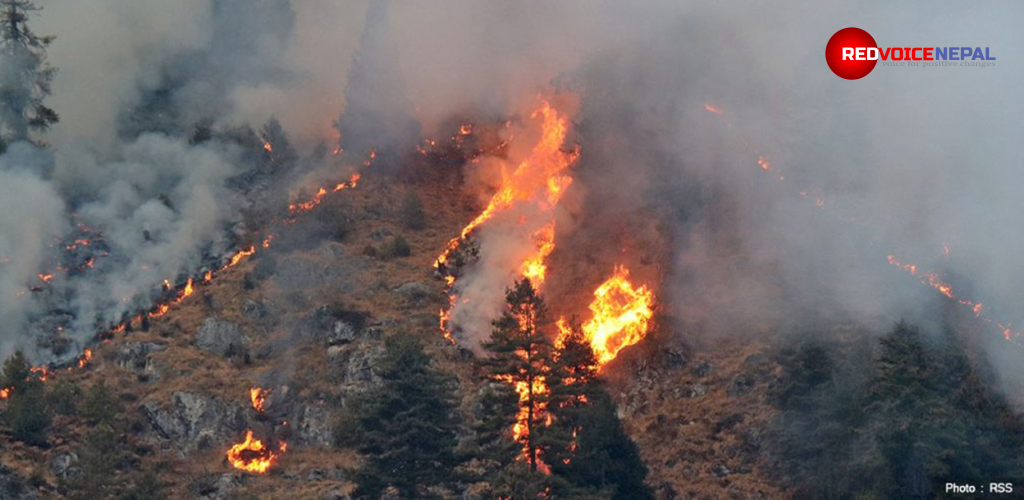
KATHMANDU: Forest fires are becoming more frequent across Nepal, posing an increasing threat to the environment, according to a new government report.
The Department of Forests and Soil Conservation says satellite data over the past 13 years shows a steady rise in fire incidents nationwide. A total of 13,622 forest fires were recorded between 2013 and 2025, highlighting what officials describe as a growing environmental challenge.
The report says fires in Nepal are largely seasonal, with nearly 89% occurring between February and April. During these months, dry weather, low humidity, rising temperatures and strong winds create ideal conditions for fires to spread. Human activities, including the burning of agricultural waste, also play a significant role.
April is identified as the most critical month, accounting for more than half of all incidents. The year 2016 saw the highest number of fires, while 2021 and 2024 also recorded notable spikes.
Recent figures show that at least 282 fires were recorded between April 2025 and mid-March 2026. Although incidents were reported across all seven provinces, Sudurpashchim was the worst affected, accounting for about a third of cases. Other provinces, including Bagmati and Karnali, also saw significant numbers.
At the district level, Kanchanpur recorded the highest number of fires, followed by Chitwan, Kailali and Surkhet.

Officials say tackling the problem will require coordinated action at all levels of government, along with support from local communities and other stakeholders. Director General Dhirendra Kumar Pradhan said forest fire management should be seen as a shared responsibility, stressing the need for better prevention, faster response and improved public awareness.
The report also raises concerns about the growing number of fires in protected areas. A total of 82 incidents were recorded in national parks and conservation areas over the same period. Chitwan National Park was the most affected, followed by Shuklaphanta National Park and Koshi Tappu Wildlife Reserve.
Experts warn that such fires can have serious consequences for biodiversity, damaging habitats and threatening wildlife. Conservationists say the impact could be long lasting if fires are not brought under control in time.
Wildlife expert Dr Ghanshyam Gurung says more needs to be done to reduce risks to both people and nature. He highlights the importance of improving awareness, expanding firebreaks and strengthening local capacity to respond to emergencies.
The report also shows that fires are concentrated in specific regions, particularly in the Tarai Chure belt and mid hill forests. Areas in Sudurpashchim as well as parts of Chitwan, Makwanpur, Surkhet, Bardiya and Banke are among the most vulnerable.
Officials say a combination of dry forest conditions, prolonged drought and increasing human activity is driving the trend. Limited resources and budget constraints are also making it harder to respond effectively.
With many of Nepal’s forests managed by local communities, experts say their involvement will be key. Without proper preparation, early warning systems and active participation, efforts to control fires are likely to fall short.
Forest specialists warn that while well managed forests tend to see fewer fires poorly managed areas face growing risks. They say stronger coordination and greater investment will be essential to prevent the problem from worsening in the years ahead.