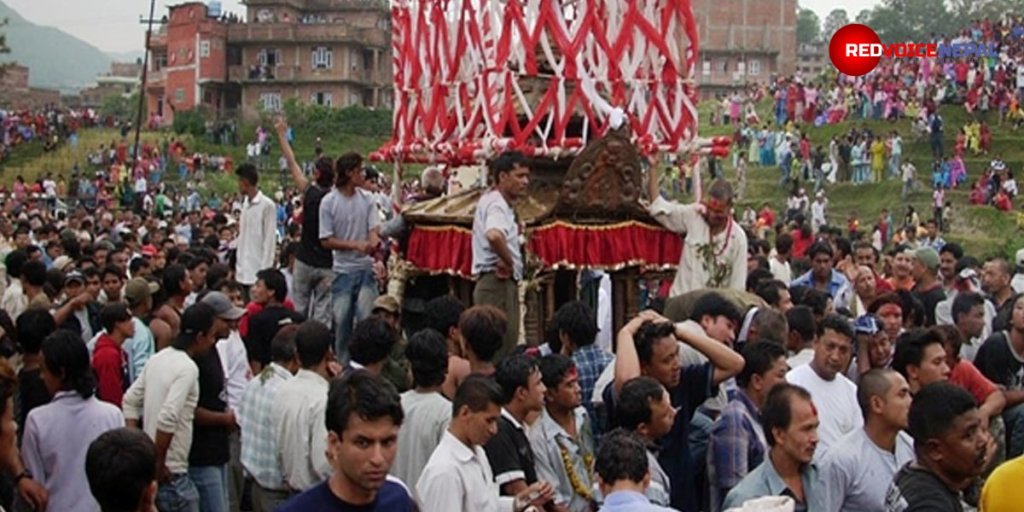
KAVREPALANCHOK: The historic town of Banepa has been celebrating the Chandeshwori Jatra for over 2,500 years, marking one of the oldest cultural festivals in the region. The festival is primarily observed by the Newar community and begins each year on the full moon day of Baisakh, continuing for three days.
This year, the festival is being celebrated from Baisakh 18, starting on Chandi Purnima and concluding on Dwitiya. The town comes alive with excitement, as locals consider it one of their most significant annual celebrations. Preparations have already intensified, with organizing committees and residents actively engaged.
During the festival, the Chandeshwori Temple is beautifully decorated like a bride. Homes are cleaned, rituals are performed, and a ceremonial sword is brought from Hanuman Dhoka, symbolizing official state participation, which adds to the festival’s importance.
Throughout the three days, community feasts are held in Newar households. Elderly residents gather in neighborhoods to sing devotional hymns, while streets and alleys remain crowded with devotees and visitors.
Devotees from distant places visit to worship Goddess Chandeshwori, believed to fulfill wishes. On the first day, a sacred lamp procession (Chirag Yatra) is carried out from Banepa to Punyashwar Mahadev Temple. Participants carry oil lamps from their homes, gather at Layaku, and proceed to Jaleshwar Mahadev for immersion rituals, accompanied by traditional musical instruments like dhimay and naykhin.
As per tradition, the goddess is placed on a chariot made of sacred wood and taken around the town. A unique ritual involves carrying a wheel less platform (khat), accompanied by energetic chants of “Lhyaka Palun Ha,” with encouragement from locals watching from their homes. Offerings prepared in households are thrown from windows onto the chariot as a mark of devotion.
On the second day, the chariot is taken to Bakutol, believed to be the site where the demon Bhandasur was defeated. Ritual worship and animal sacrifices are conducted at designated religious sites. The idol is later transferred to a smaller chariot and brought back, marking the continuation of traditional practices.
Animal sacrifices are also part of the ritual, where goats are offered to deities within the temple. Some portions are distributed among specific communities, while the remaining meat is shared with the crowd as prasad in a ritual known as “Kalanda.”
Due to the festival’s importance, local institutions, organizations, and schools in Banepa remain closed during the celebration. Many people originally from Banepa return home from different places to take part in the पूजा, as it is widely believed that the festival should not be missed.
According to legend, around 2,500 years ago, a demon named Chandasur gained a boon that no man could kill him, leading to chaos across the worlds. Eventually, the goddess manifested as Chandeshwori, defeated the demon, and protected the gods. The festival is celebrated to commemorate this victory and the protection of divine forces.