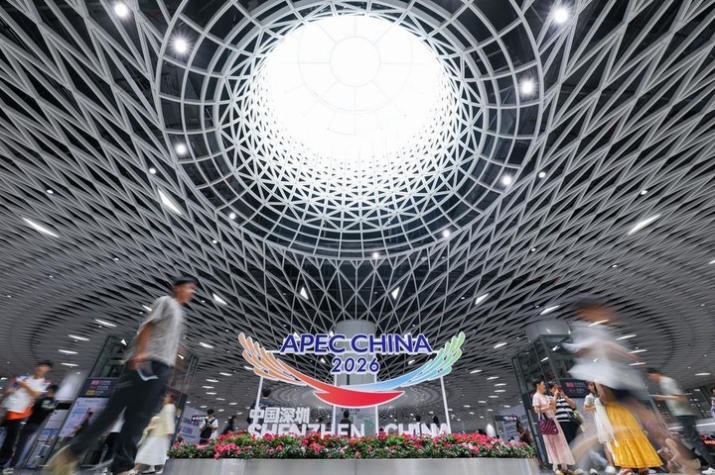
SHENZHEN: China’s economic transformation, technological advancement and expanding role in global trade will be in focus as Shenzhen hosts the 33rd Asia-Pacific Economic Cooperation (APEC) Economic Leaders’ Meeting on November 18–19.
The summit marks the third time China has hosted the APEC Economic Leaders’ Meeting, following gatherings in Shanghai in 2001 and Beijing in 2014. The upcoming meeting is expected to provide a platform for regional economies to strengthen cooperation on trade, investment, digital technology and connectivity.
Shenzhen’s selection as host city reflects China’s remarkable economic development over the past several decades. Once a small town surrounded by rice fields and oyster farms, Shenzhen became a Special Economic Zone in 1980 and emerged as one of China’s leading centres for manufacturing, innovation and international business.
The city’s development was driven by economic reforms, foreign investment and greater access to international markets. Over time, it became home to major technology and manufacturing companies, including Huawei, Tencent, DJI and BYD.
China’s engagement with APEC has also played a significant role in its integration into the global economy. The country joined the regional forum in 1991 and later became a member of the World Trade Organization in 2001, opening further opportunities for international trade and investment.
At the 2014 Beijing summit, China placed greater emphasis on regional connectivity and economic integration. Initiatives such as the Belt and Road Initiative and the Asian Infrastructure Investment Bank reflected its expanding role in regional development cooperation.
The country’s development agenda has since expanded to include technological innovation, artificial intelligence, renewable energy and environmental sustainability. China has become a major global supplier of solar modules and wind power equipment while investing heavily in electric vehicles, energy storage and industrial automation.
The upcoming Shenzhen summit is expected to focus on advancing free trade, strengthening regional connectivity and exploring opportunities in the digital economy and artificial intelligence.
Coordination between the Regional Comprehensive Economic Partnership (RCEP) and the Comprehensive and Progressive Agreement for Trans-Pacific Partnership (CPTPP) is also among the issues expected to receive attention.
Regional economies are additionally looking to strengthen cooperation under the APEC Connectivity Blueprint for 2015–2025.
Against a backdrop of slower global economic growth, technological disruption and growing development gaps, the meeting comes at an important time for Asia-Pacific cooperation.
As China hosts the gathering, Shenzhen is expected to showcase how innovation, manufacturing capabilities and international partnerships have shaped its economic development, while highlighting the country’s ambitions for the next phase of regional and global cooperation.