China is stepping up international cooperation in space, opening its space station to foreign astronauts, sharing lunar samples with scientists from around the world and extending satellite-based services to support other countries.
As its space programme continues to develop, Beijing is placing greater emphasis on international partnerships, offering countries opportunities to participate in space missions, access scientific resources and benefit from space technology for peaceful purposes.
First foreign astronaut aboard China’s space station
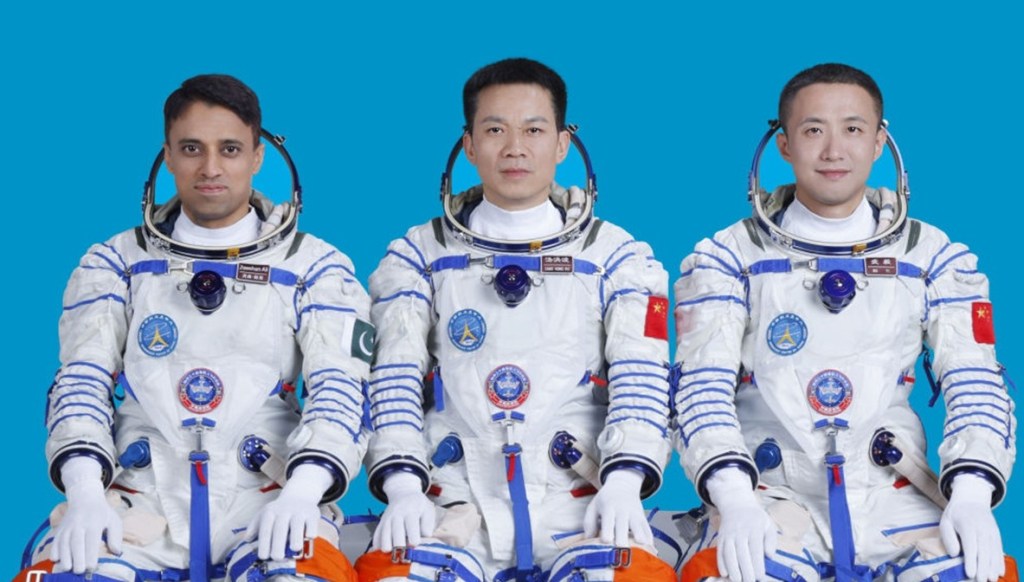
A major milestone in China’s international space cooperation was achieved on November 25, when Pakistani astronaut Muhammad Zeeshan Ali joined Chinese astronauts Tang Hongbo and Wu Yi aboard the Shenzhou-24 spacecraft.
The spacecraft launched from the Jiuquan Satellite Launch Center in northwest China’s Gobi Desert before successfully docking with the Tiangong space station at 11:56 a.m. Beijing time (0356 GMT), according to the China Manned Space Agency (CMSA).
Ali became the first foreign astronaut to enter China’s space station and the first Pakistani national to travel into space.
His participation followed an agreement signed between China and Pakistan in February 2025 on astronaut selection and training. The development represents a significant expansion of bilateral cooperation, which has progressed from satellite development to human spaceflight.
During the mission, four joint China-Pakistan experiments in biotechnology and materials science will be conducted. Ali will also undertake an experiment involving photosynthetic cyanobacteria in space.
Speaking about the mission, Ali highlighted the importance of international partnership, saying it was an opportunity to demonstrate cooperation in orbit and promote the peaceful use of outer space.
Pakistani President Asif Ali Zardari also welcomed the achievement, describing it as evidence of China’s progress in space science and technology and its commitment to peaceful space exploration.
International partnerships in lunar exploration
China is also expanding international participation in its lunar exploration programme, inviting foreign countries and research institutions to contribute scientific instruments, conduct experiments and study lunar materials.
The Chang’e-4 and Chang’e-6 missions each carried four international scientific payloads. Meanwhile, the upcoming Chang’e-7 mission is scheduled to carry six scientific instruments developed by six countries and an international organization.
The Chang’e-8 mission is expected to include payloads from 11 countries and regions, as well as one international organization.
Both missions are expected to support the proposed International Lunar Research Station, an ambitious scientific project designed to establish research facilities on the lunar surface, in lunar orbit and on Earth.
So far, 17 countries and international organizations and more than 50 international research institutions have joined the initiative.
China is also encouraging international scientific research by sharing lunar samples collected during its missions. In April 2025, the China National Space Administration (CNSA) announced that researchers from France, Germany, Japan, Pakistan, the United Kingdom and the United States had received access to lunar samples returned by the Chang’e-5 mission in 2020.
The initiative has drawn positive responses from the international scientific community. Frederic Moynier, a cosmochemist at the Paris Institute of Planetary Physics, described China’s approach as a positive example of scientific cooperation.
Similarly, British planetary scientist Mahesh Anand of the Open University called the opportunity a great honour and privilege, expressing interest in developing further international research partnerships.
The CNSA said its lunar exploration programme follows the principles of equality, mutual benefit, peaceful utilization and win-win cooperation. It also reiterated its commitment to accepting international applications for lunar sample research.
Satellite technology serving countries worldwide
China’s international space cooperation also extends to satellite-based services that support transportation, agriculture, weather forecasting and disaster management.
The BeiDou Navigation Satellite System (BDS), China’s independently developed global navigation system, provides high-precision positioning and navigation services to users in more than 140 countries and regions.
Its applications include transportation management, agricultural operations and meteorological monitoring. The system has also been incorporated into the standards of 11 international organizations, including the International Civil Aviation Organization, the International Maritime Organization and COSPAS-SARSAT, a global satellite-based search and rescue system.
China’s Fengyun meteorological satellites are another important component of its international space services. They provide weather observations and data that help countries monitor tropical cyclones, heavy rainfall, wildfires and other extreme weather events.
Through the World Meteorological Organization’s (WMO) Integrated Global Observing System, Fengyun satellite data are shared internationally to strengthen weather forecasting and climate monitoring.
WMO President Abdulla Al Mandous has described the satellite observations as essential to filling gaps in global climate and disaster monitoring networks.
The practical importance of this cooperation was demonstrated during a severe mudslide along the China-Nepal border in August. Chinese meteorological authorities provided Nepal with satellite information, rainfall monitoring and weather services to assist disaster assessment, rescue operations and emergency response.
China has also developed the MAZU early-warning system, which combines meteorological satellite data with artificial intelligence-based forecasting models. The platform provides more than 200 cloud-based early-warning products and services to over 50 countries.
In July, United Nations Secretary-General Antonio Guterres recognized China as an important partner in global early-warning initiatives, noting that its satellite platforms and AI-based forecasting technologies were helping dozens of countries strengthen their disaster preparedness systems.
Through human spaceflight, lunar exploration, scientific resource sharing and satellite services, China is seeking to expand its role in international space cooperation while promoting the peaceful use of space technology for the benefit of the global community.
Beijing Review