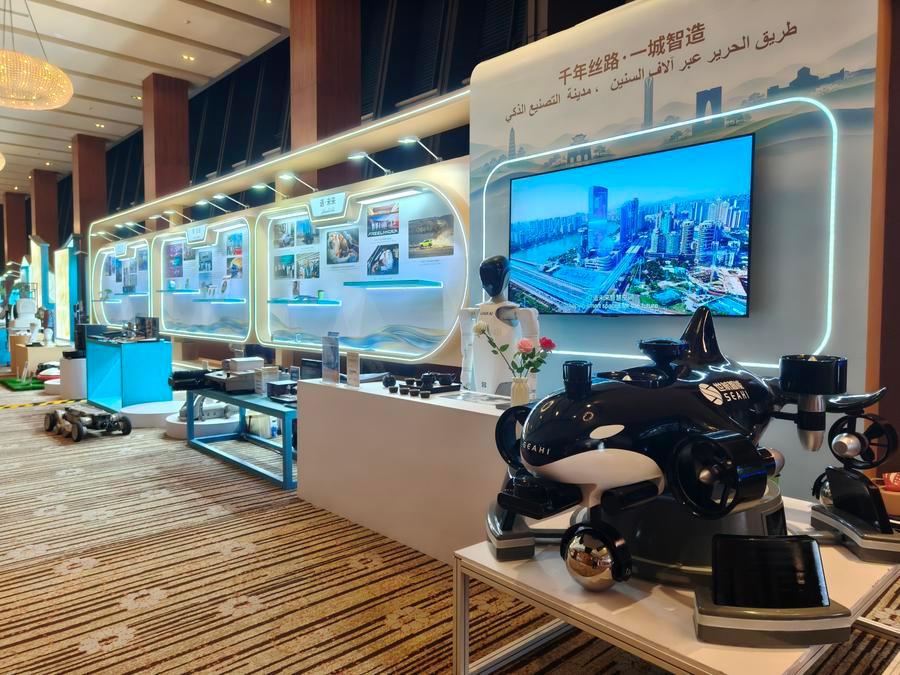
SUZHOU: An advanced orca-shaped underwater robot developed by a Chinese technology company has attracted significant attention from Arab delegates at a major political dialogue in eastern China, highlighting growing opportunities for technological and economic cooperation between China and Arab countries.
The marine robot, named “Orca Max”, was developed by Suzhou-based Seahi Robotics. Designed to operate at depths ranging from the ocean surface to 10,000 metres, the device can perform underwater operations autonomously without requiring manual remote control.
According to Cao Ying, co-founder of the company, the robot is capable of navigating challenging marine environments, including strong ocean currents, deep-sea areas without natural light and locations where communication signals are unavailable.
The technology attracted the interest of Freddy Elbaiady, vice president of the Egyptian Social Democratic Party and a member of Egypt’s House of Representatives, who visited the company’s exhibition booth during the Fifth China-Arab States Political Parties Dialogue in Suzhou, Jiangsu Province.
Elbaiady said Egypt’s numerous ports and extensive maritime activities could create substantial demand for the technology. He identified potential applications in ship cleaning and maintenance, port inspections, dredging, and the construction and maintenance of offshore renewable energy facilities.
Cao said the robot has already been deployed at more than 70 major ports worldwide. Powered by the company’s self-developed artificial intelligence model, it is designed to provide efficient and sustainable solutions for marine operations.
The two-day dialogue, which began on Friday, brought together more than 100 political and organizational leaders, business representatives, researchers and media professionals from 22 Arab countries.
The gathering also featured the inaugural China-Arab Business Dialogue on the Belt and Road Initiative, bringing together entrepreneurs from more than 200 Chinese and Arab companies to discuss cooperation in trade, investment, science and technology.
Logistics and renewable energy were among the key areas of discussion. Saleh Al Khabti, president of Acwa China, highlighted the opening of a direct container shipping route between Taicang Port in Suzhou and Jeddah, Saudi Arabia, in October. The route is expected to reduce shipping time by two to three weeks.
Al Khabti said his company plans to invest up to 30 billion US dollars in China by 2030 and increase its annual procurement of Chinese equipment by 15 billion dollars. The company is also expanding cooperation in renewable energy, energy storage, green hydrogen and water desalination.
The event comes as China and Arab countries mark 70 years of diplomatic relations and a decade of the China-Arab States Political Parties Dialogue mechanism.
Bilateral trade between China and Arab countries reached 422 billion US dollars in 2025, while cooperation has expanded into renewable energy, digital technologies, transportation and infrastructure.