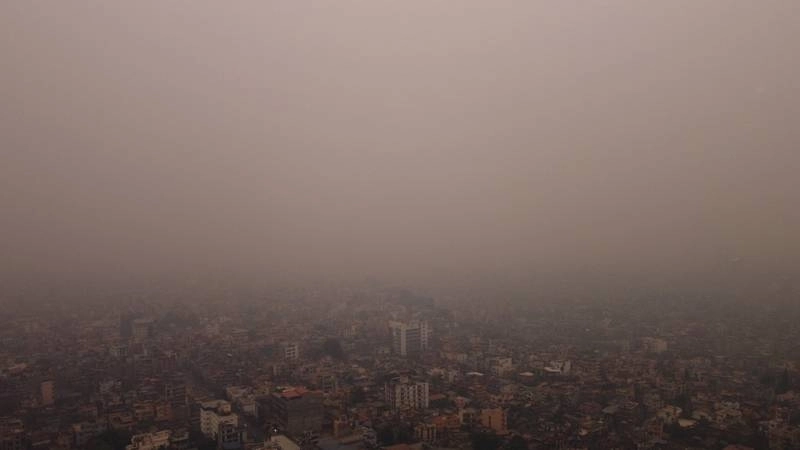
KATHMANDU: Air pollution is worsening in the Kathmandu Valley with the arrival of the dry season, pushing air quality into unhealthy levels across several neighbourhoods and raising health concerns.
According to IQAir, a Switzerland-based air quality monitoring organisation, Kathmandu recorded an overall Air Quality Index (AQI) of 111 on Friday morning. The situation remained concerning in several parts of the valley, with pollution levels expected to stay unhealthy through Sunday.
The Baneshwor area recorded an AQI of 153 on Thursday, while the reading had declined to 127 by 9:15 am on Friday.
Data from the Kathmandu Metropolitan City’s air quality monitoring dashboard also showed unhealthy air conditions in multiple locations, including Swayambhu, Balaju, Teku, Dallu, Thapathali, Kshetrapati, Jadibuti, Asan, Kamaladi, Shantinagar, Chabahil, Lainchaur and Handigaun.
The metropolitan city has called on concerned authorities and the public to avoid activities that contribute to air pollution.
Air pollution typically increases in Kathmandu during the dry months as reduced rainfall allows dust and other pollutants to remain suspended in the atmosphere.
An AQI between 101 and 150 is considered unhealthy for sensitive groups, including children, older people and individuals with respiratory or chronic health conditions. A reading between 151 and 200 is classified as unhealthy for the general population.
Fine particulate matter known as PM2.5 is a major concern because its tiny particles, measuring less than 2.5 micrometres in diameter, can penetrate deep into the lungs and enter the bloodstream. Long-term exposure is associated with serious health risks, including respiratory and cardiovascular diseases and lung cancer.
The World Health Organization (WHO) recommends that average PM2.5 concentrations should remain below five micrograms per cubic metre annually and 15 micrograms per cubic metre over 24 hours.
Delhi air pollution reaches severe category
Meanwhile, air pollution has reached alarming levels in India’s capital, New Delhi, where the AQI crossed 400 on Friday morning.
According to India’s Central Pollution Control Board (CPCB), Delhi recorded an AQI of 422 at 8 am, placing the city in the ‘severe’ category.
Monitoring stations reported an AQI of 421 near Jawaharlal Nehru Stadium and 414 in Najafgarh, while Chandni Chowk recorded 391.
Under the CPCB classification, an AQI between 401 and 500 is considered severe, a level that can affect healthy people and pose serious health risks to those with existing medical conditions.
An AQI of 301 to 400 falls under the ‘very poor’ category, while readings between zero and 50 are classified as ‘good’. Levels between 51 and 100 are considered ‘satisfactory’.
The deteriorating air quality in both Kathmandu and Delhi highlights the growing pollution challenges faced by South Asian cities during the dry season.